


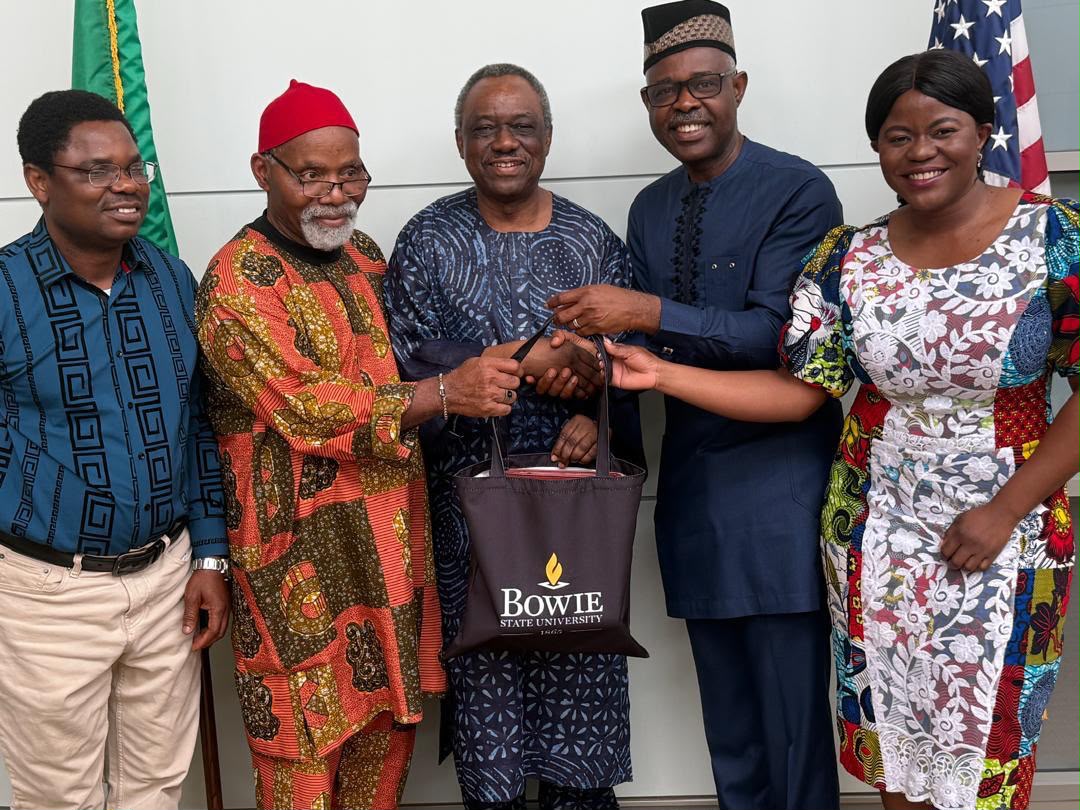
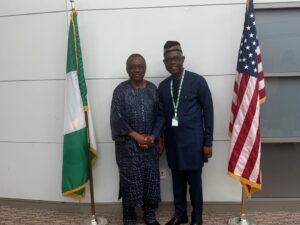
A team of academicians from Bowie State University paid a courtesy visit to His Excellency, Ambassador Lateef Kayode Are, Ambassador of the Federal Republic of Nigeria to the United States, in a meeting marked by strategic dialogue, shared vision, and a mutual commitment to strengthening educational cooperation between Nigeria and the United States.
Ambassador Are, a former Director-General of Nigeria’s State Security Service, brings to his diplomatic assignment extensive leadership experience, distinguished academic credentials, and specialized diplomatic training. His commitment to advancing education, innovation, trade, and strategic partnerships continues to reinforce the enduring relationship between Nigeria and the United States.
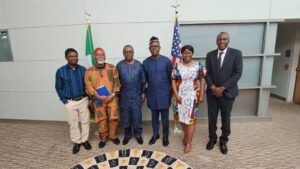
The Bowie State University team was led by Prof. George Ude, Chair of the Department of Natural Sciences and Chairman of the Board of Trustees of DNA Learning Center Nigeria. Other members of the team included Prof. Benjamin Arah, Associate Dean of the College of Arts and Sciences; Prof. David Igwe, Assistant Professor of Biotechnology; and Dr. Chimdimnma Esimai, Programs Manager for the Course-based Undergraduate Research Experiences (CURE) Program.
Also participating in the meeting was Mr. Chukwudi Igboeli, Minister (Head Education Section), Embassy of the Federal Republic of Nigeria, Washington, D.C., who coordinated the engagement as part of the Embassy’s ongoing efforts to promote strategic academic partnerships and strengthen educational cooperation between Nigeria and the United States.
The discussions centered on strengthening Nigeria’s higher education system, expanding research capacity, promoting scientific innovation, and equipping students with future-ready competencies required to thrive in an increasingly knowledge-driven and globally competitive economy.
Professor Ude presented four transformative educational initiatives that offer practical models for advancing scientific research, biotechnology, innovation, and workforce development in Nigeria.
The first initiative, the Course-based Undergraduate Research Experiences (CURE) Program, currently engages more than 1,000 undergraduate students annually at Bowie State University in authentic, research-intensive learning. Through faculty-guided projects across Science, Technology, Engineering, and Mathematics (STEM) disciplines, as well as non-STEM fields, students gain early exposure to meaningful research experiences that develop critical thinking, analytical reasoning, and problem-solving skills while enhancing their competitiveness for postgraduate education and professional careers.
The second initiative, the Back to Science (BATOSCIN) Initiative, serves as an exemplary model of international collaboration in science education. Supported by the United States Embassy in Nigeria, BATOSCIN has provided immersive molecular biology training to more than 200 Nigerian secondary school students and 40 teachers. By engaging participants in authentic laboratory research and biodiversity studies, the initiative helps bridge Nigeria’s science knowledge gap, inspires early interest in STEM careers, and strengthens the country’s future scientific workforce through collaboration among Bowie State University, Godfrey Okoye University, and the Dolan DNA Learning Center, New York.
The team also highlighted the transformative role of the DNA Learning Center Nigeria (DNALC Nigeria) at Godfrey Okoye University, which serves as Nigeria’s national hub for modern genetics education. Modeled after the internationally acclaimed Dolan DNA Learning Center in New York, DNALC Nigeria provides students and educators with hands-on molecular biology training through laboratory workshops, curriculum development, teacher capacity building, and research-based learning, thereby expanding access to cutting-edge biotechnology education across Nigeria.
Professor Ude further introduced the Center for DNA Forensics and Criminal Investigations (CEDFOCI), the fourth strategic initiative. Conceived during his four-month sabbatical at Godfrey Okoye University and co-funded by the Enugu State Government and Godfrey Okoye University, CEDFOCI is a specialized center dedicated to forensic science, genomics, criminal investigations, advanced research, and professional training. The Center is designed to strengthen Nigeria’s capacity in DNA analysis, forensic investigations, public health research, and scientific innovation while supporting the administration of justice through modern forensic technologies. CEDFOCI enjoys the full support of Godfrey Okoye University’s Vice Chancellor Rev. Fr. Prof. Dr. Christian Anieke, whose strong leadership over the years has fostered the success of DNALC Nigeria and broadened partnership between GOU and Bowie State University
Ambassador Are commended Professor Ude and his team for their visionary leadership and the remarkable impact of these initiatives, particularly in the areas of education, science and technology, innovation, youth empowerment, human capital development, and national competitiveness.
A major highlight of the meeting was the discussion of a proposed strategic partnership between the Embassy of Nigeria and Bowie State University. According to Prof. Arah, the proposed collaboration would establish structured academic pathways for Nigerian international students, Nigerians in Diaspora, as well as children of Embassy staff to pursue higher education at Bowie State University. Both parties agreed that the initiative would broaden educational opportunities for Nigerian students while enriching Bowie State University’s academic community through greater diversity, academic excellence, and cross-cultural engagement. The partnership is part of President Aminta H. Breaux’s Boldly Forward Strategic Plan which reflects Bowie State University’s strategic commitment to “academic innovation, student success, and global engagement” and demonstrates how international partnerships can strengthen workforce readiness and expand access to high‑impact learning experiences. This emerging relationship also directly supports President Breaux’s emphasis on “building distinctive programs and expanding research capacity,” creating new pathways for all learners while advancing shared goals in science, education, and diplomacy.
The meeting also explored strategies for ensuring the long-term sustainability of research institutes and innovation centers. Both sides emphasized the importance of diversified public and private sector funding, stronger industry partnerships, international collaboration, technology transfer, and continuous innovation as essential pillars for sustaining globally competitive research ecosystems.
Ambassador Are and the Bowie State University delegation further exchanged views on the evolving direction of United States engagement with Africa, noting the increasing emphasis on trade, investment, innovation, entrepreneurship, and mutually beneficial partnerships alongside traditional development cooperation. They observed that this evolving policy environment presents significant opportunities for Nigeria and the United States to deepen collaboration in higher education, scientific research, technology, innovation, workforce development, and economic growth, while creating enduring value for both nations.
In concluding the meeting, Ambassador Are reaffirmed the Embassy’s commitment to fostering strategic partnerships with leading academic and research institutions that advance Nigeria’s national development priorities through education, scientific research, innovation, and human capital development. He emphasized that the Embassy would continue to facilitate meaningful collaborations that promote knowledge exchange, institutional linkages, and sustainable development between Nigeria and the United States.
The Bowie State University team expressed appreciation for the Ambassador’s warm reception, thoughtful engagement, and strong commitment to educational diplomacy. The team reaffirmed its readiness to work closely with the Embassy in translating the shared vision discussed during the meeting into impactful collaborative programmes and institutional partnerships. Both parties expressed confidence that the visit had laid a solid foundation for a mutually beneficial partnership that will deepen educational cooperation, expand research opportunities, strengthen institutional capacity, and further reinforce the longstanding friendship between Nigeria and the United States.